Beet root has gone from a salad vegetable to one of the most searched-for supplement ingredients in the wellness world — and unlike a lot of trending ingredients, there's a genuine, well-studied reason for it. Here's a full breakdown of what beet root actually does, how it works, and how to choose a good one.
What Is Beet Root, and Why Is Everyone Talking About It?
Beet root (the root of the beet plant, Beta vulgaris) is naturally rich in dietary nitrates, betalains (the pigments that give it its deep red color), and a range of vitamins and minerals. In supplement form, it's typically sold as a juice, a powder, or — for convenience — a compressed tablet.
The Science: How Beet Root Works in the Body
The headline reason beet root gets so much attention is its dietary nitrate content. When you consume nitrates, your body converts them into nitrite and then into nitric oxide, a molecule that helps blood vessels relax and widen. Nutrition researchers, including those cited by the National Institutes of Health's Office of Dietary Supplements, describe this nitrate-to-nitric-oxide pathway as one of the better-understood mechanisms in sports nutrition and cardiovascular research — it's the same pathway behind why beet root is such a popular pre-workout and cardiovascular-support ingredient.
Potential Benefits of Beet Root
Exercise & Endurance
Nitric oxide production is linked to improved blood flow to working muscles, which is why beet root shows up so often in pre-workout formulas and endurance-athlete routines.
Cardiovascular Support
Because nitric oxide helps relax blood vessels, beet root is commonly used as part of a heart-healthy lifestyle alongside diet and exercise — though it isn't a substitute for medical treatment of any cardiovascular condition.
Antioxidant Content (Betalains)
Betalains are the pigments responsible for beet root's color, and they're also being studied for their antioxidant properties — helping the body manage everyday oxidative stress.
Digestive & Gut Health
Beet root contains fiber and naturally occurring compounds that support a healthy gut environment as part of an overall balanced diet.
Beet Root Juice vs. Powder vs. Tablets
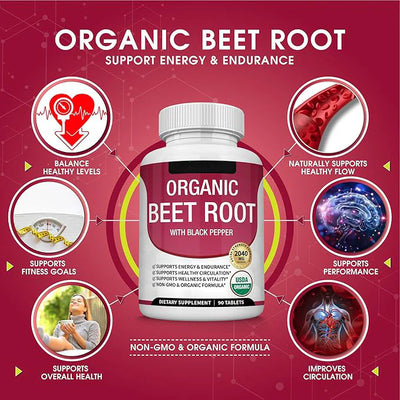
Beet root juice delivers a concentrated dose but can be messy, has a strong earthy taste, and is harder to dose consistently. Powder is more concentrated and shelf-stable but still requires mixing. Tablets — like our Organic Beet Root Powder Tablets — offer the same concentrated dose in a format you can take on the go, with no mixing, mess, or staining.
How Much Beet Root Should You Take?
There's no single official recommended dose, but most studies and commercial products use somewhere in the range of 3–6 grams of beet root powder equivalent per serving. Always follow the serving size on your specific product, since concentration varies between brands.
Who Should Be Cautious With Beet Root
- People with a history of kidney stones, since beets contain oxalates — nutrition researchers commonly advise people with a history of oxalate-related kidney stones to moderate high-oxalate foods generally.
- People on blood pressure medication, since beet root's effect on blood vessels could add to the medication's effect — talk to your doctor first.
- It's completely normal (and harmless) for beets to turn urine or stool pink or red — this is called beeturia and isn't a cause for concern.
What to Look for in a Quality Beet Root Supplement
- Organic sourcing — fewer pesticide residues.
- Clear dosage per serving — look for the actual milligram amount, not a vague "proprietary blend."
- No artificial colors or flavors — beet root doesn't need them.
- A format you'll actually stick with — the best supplement is the one you take consistently.
Frequently Asked Questions
Does beet root really increase energy?
Many people report feeling more energized, likely tied to improved blood flow and oxygen delivery to muscles — though individual response varies.
How long does it take to work?
Nitric oxide effects from a single dose are typically most noticeable within a few hours; consistent daily use is generally recommended to build up baseline levels.
Can I take beet root every day?
Most people can take a daily serving as part of a normal diet and supplement routine — check with your healthcare provider if you have any underlying health conditions.
Does it interact with medication?
Beet root may interact with blood pressure medication in particular. If you're on any prescription medication, check with your doctor or pharmacist before adding a new supplement.
The Bottom Line
Beet root is one of the rare trending supplement ingredients with real, repeatable science behind its core mechanism. If you want a mess-free way to add it to your routine, our Organic Beet Root Powder Tablets pack 2040mg of organic beet root into a simple daily tablet.
This article is for general information only and is not medical advice. This product is a dietary supplement and is not intended to diagnose, treat, cure, or prevent any disease. Talk to your healthcare provider before starting any new supplement, especially if you take medication or have a medical condition.
More in Natural Energy & Circulation
- Yerba Mate for Natural Energy: What It Is and How It Compares to Coffee
- NMN vs NAD+: What's the Difference? (Longevity & Cellular Energy)